Posts Tagged with "PFH"

既に発行済みのブログであっても適宜修正・追加することがあります。
We may make changes and additions to blogs already published.

PMHF論文sae2020 (2)

posted by sakurai on August 13, 2020 #291

アブストラクト(続き)

論文sae2020$\dagger$のアブストラクトの続きです。

The new version of the standard expands the PMHF concept by further promoting a new metric “average probability of failure per hour over the operational lifetime of the item”, which has not been commonly used by the reliability engineering community.

本規格の新バージョンでは、これまで信頼性工学の分野では一般的に使用されていなかった「項目の動作寿命における1時間当たりの平均故障確率」という新しい指標をさらに推進することで、PMHFの概念を拡張しています。

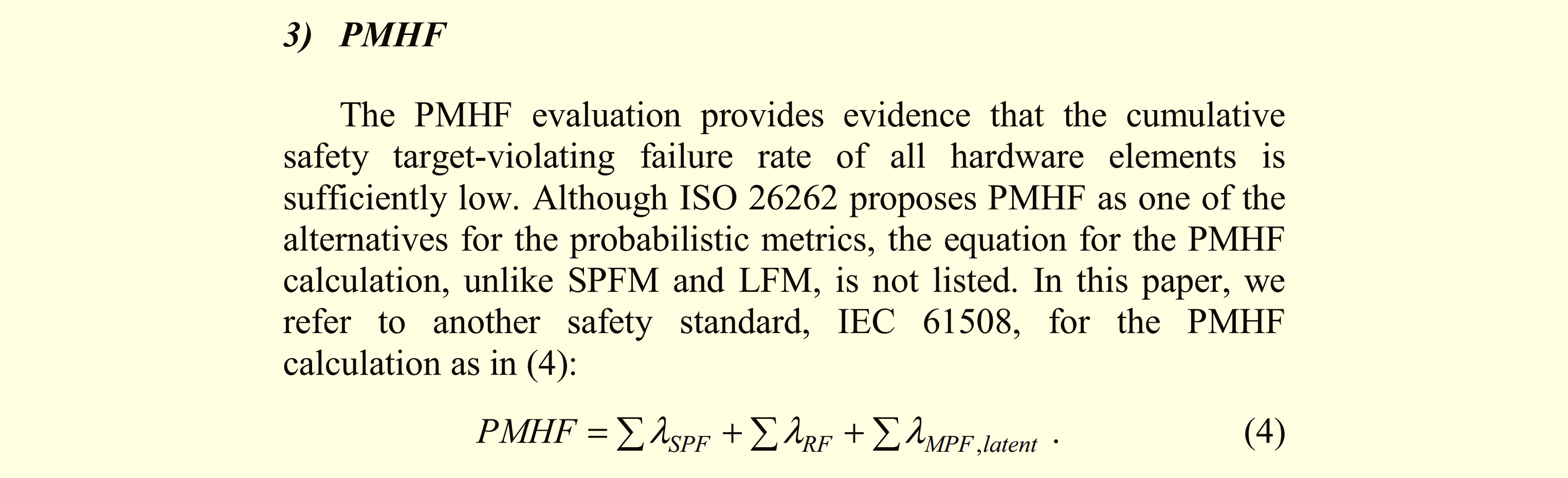
既に2つ問題があります。まず1つ目は、新バージョンになってPMHFが進化した、拡張されたと書かれていますが、PMHFの文字上の定義は初版と第2版の間では変わっていません。規格を見てみましょう。

ISO 26262:2011(初版) Part5

  • 9.4.2.1 "Quantitative target values for the maximum probability of the violation of each safety goal due to random hardware failures"
  • 9.4.2.2 "Quantitative target values of requirement 9.4.2.1 shall be expressed in terms of average probability per hour over the operational lifetime of the item"

ISO 26262:2018(第2版) Part5

  • 9.4.2.1 "Quantitative target values of requirements 9.4.2.2 or 9.4.2.3 shall be expressed in terms of average probability per hour over the operational lifetime of the item"
  • 9.4.2.2 "Quantitative target values for the maximum probability of the violation of each safety goal at item level due to random hardware failures"

初版と第2版で定義の順番が変わっていたり、"at item level"と微小な追加があったりしますが、基本的には同じことを言っています。日本語に訳せば、「アイテムの稼働期間中の1時間あたりの平均確率で表した、ランダムハードウェア故障によるアイテムレベルでの各安全目標違反の最大確率の定量的目標値」となります。

もう一つの問題は、信頼性工学の分野では一般的に使用されていなかった「項目の動作寿命における1時間当たりの平均故障確率」という部分で、これは既にISO 12489の3.1.23に書かれているPFHが相当します。ISO 12489の原文を読めば3.1.23の平均故障頻度(average failure frequency)の項に、

The average failure frequency is also called “Probability of Failure per Hour” (PFH) by the standards related to functional safety of safety related/instrumented systems (e.g. IEC 61508[2]): PFH = $\overline{w}(T)$ where $T$ is the overall life duration of the system.

平均故障頻度は、安全関連/計装システムの機能安全に関連する規格(例:IEC 61508[2])では、"Probability of Failure per Hour"(PFH)とも呼ばれている。PFH = $\overline{w}(T)$ ここで、$T$はシステムの全体的な耐用年数である。

と書かれています。平均故障頻度はPFHとも呼ばれ、故障頻度(=故障確率密度)を0から車両寿命まで積分したものを車両寿命で平均化したものです。

この段落の問題をまとめると、

  • PMHFの定義は第2版で拡張されていない(=初版と同じ定義である)
  • PMHFは新しいなじみのない概念ではない(=ISO 12489で既に定義されているPFHと同じ)

$\dagger$: Kleyner, A. and Knoell, R., “Calculating Probability Metric for Random Hardware Failures (PMHF) in the New Version of ISO 26262 Functional Safety - Methodology and Case Studies,” SAE Technical Paper 2018-01-0793, 2018


左矢前のブログ 次のブログ右矢

posted by sakurai on October 16, 2018 #66

ISO/TR 12489:2013(E)において、信頼性用語の定義がまとめてあるため、それを記載します。ただし、弊社の考えを交えており、そのまま引用しているわけではありません。以下に$X_\text{item}$をアイテム$item$の無故障運転継続時間(failure free operating time)とするとき、

信頼度(Reliability)

$$ R_\text{item}(t):=\Pr\lbrace\text{item not failed in }(0, t]\rbrace=\Pr\lbrace\mathrm{item\ up\ at\ }t\rbrace=\Pr\lbrace t\lt X_\text{item}\rbrace \tag{66.1} $$ 非修理系システムで、時刻$t$までに一度も故障していない確率。非修理系なので、一度でも故障すると故障しっぱなしになるため、一度も故障していない確率です。

不信頼度(Unreliability, Cumulative Distribution Function, CDF)

$$ F_\text{item}(t):=\Pr\lbrace\mathrm{item\ failed\ in\ }(0, t]\rbrace=\Pr\lbrace\mathrm{item\ down\ at\ }t\rbrace=\Pr\lbrace X_\text{item}\le t\rbrace \tag{66.2} $$ 非修理系システムで、時刻$t$までに故障する確率。

非修理系なので、一度でも故障すると故障しっぱなしになるため、時刻が0からtまでに故障したことがある確率です。等号は有っても無くても値は変わりません。

故障密度(Probability Density, Probability Density Function, PDF)

$$ f_\text{item}(t):=\lim_{dt \to 0}\frac{\Pr\lbrace\mathrm{item\ fails\ in\ }(t, t+dt]\cap\mathrm{item\ up\ at\ } t\rbrace}{dt}=\frac{dF_\text{item}(t)}{dt} \tag{66.3} $$ 又は、微小故障確率形式として、 $$ f_\text{item}(t)dt=\Pr\{\mathrm{item\ fails\ in\ }(t, t+dt]\cap\mathrm{item\ up\ at\ } t\}\\ =\Pr\lbrace t\lt X_\text{item}\le t+dt\rbrace\\ =\Pr\{X_\text{item}\in dt\} \tag{66.4} $$ 非修理系システムで、時刻$t$で、単位時間あたりに故障する確率。正確には、時刻$t$から$t+dt$までに故障する微小確率を$dt$で割り、単位時間あたりに直したもの。

【証明】 条件付き確率公式及び、確率の加法定理を用いて、 $$ f_\text{item}(t):=\lim_{dt \to 0}\frac{\Pr\lbrace t\lt X_\text{item}\le t+dt\rbrace}{dt} \\ =\lim_{dt \to 0}\frac{\Pr\lbrace t\le X_\text{item}\rbrace+\Pr\lbrace X_{item}\le t+dt\rbrace - \Pr\lbrace t\le X_\text{item} \cup X_\text{item}\le t+dt\rbrace}{dt} \\ =\lim_{dt \to 0}\frac{R(t)+F(t+dt)-1}{dt}=\lim_{dt \to 0}\frac{F(t+dt)-F(t)}{dt}=\frac{dF_\text{item}(t)}{dt} \tag{66.5} $$

(瞬間)故障率(Failure Rate)

$$ \lambda_\text{item}(t):=\lim_{dt \to 0}\frac{\Pr\lbrace\mathrm{item\ fails\ in\ }(t, t+dt]\ |\ \mathrm{item\ not\ failed\ at\ } t\rbrace}{dt}=\frac{f_\text{item}(t)}{R_\text{item}(t)} \tag{66.6} $$ 非修理系システムで、時刻$t$で稼働している条件において、単位時間あたりに故障する条件付き確率。正確には、時刻$t$から$t+dt$までに故障する条件付き確率を$dt$で割り、単位時間あたりとしたもの。ISO 26262の場合は、確率分布が指数分布のため、故障率は定数として扱います。

【証明】 条件付き確率の式及び、上記$f_\text{item}(t)$の式を用いて $$ \lambda_\text{item}(t):=\lim_{dt \to 0}\frac{\Pr\lbrace X_\text{item}\le t+dt \cap t \le X_\text{item}\rbrace}{dt}\frac{1}{\Pr\lbrace t \le X_\text{item}\rbrace}=\frac{f_\text{item}(t)}{R_\text{item}(t)} \tag{66.7} $$ 又は、微小故障条件付き確率形式として、 $$ \lambda_\text{item}(t)dt=\Pr\lbrace\mathrm{item\ fails\ in\ }(t, t+dt]\ |\ \mathrm{item\ not\ failed\ at\ } t\rbrace\\ =\Pr\{t\lt X_\text{item}\le t+dt\ |\ t\le X_\text{item}\}\\ =\Pr\{X_\text{item}\in dt\ |\ t\le X_\text{item}\} \tag{66.8} $$

稼働度((Point) Availability)

$$ A_\text{item}(t):=\Pr\lbrace\mathrm{item\ up\ at\ }t\rbrace \tag{66.9} $$ 修理系システムで、時刻$t$で稼働している確率。

不稼働度((Pont) Unavailability, PUA)

$$ U_\text{item}(t):=\Pr\lbrace\mathrm{item\ down\ at\ }t\rbrace=1-A_\text{item}(t) \tag{66.10} $$ 修理系システムで、時刻$t$で不稼働な確率。

無条件故障強度(Unconditional Failure Intensity, UFI; Failure Frequency; ROCOF)

$N_\text{item}(t)$を時刻$t$までの累積故障回数とする。

$$ z_\text{item}(t):=\lim_{dt\rightarrow0+}\frac{E\{N_\text{item}(t+dt)-N_\text{item}(t)\}}{dt} \tag{66.11} $$ 又は、微小増分形式として $$ E\{N_\text{item}(t+dt)-N_\text{item}(t)\}=z_\text{item}(t)dt+o(dt) \tag{66.12} $$

平均無条件故障強度(Average UFI, AROCOF)

無条件故障強度(UFI)の車両寿命間$T_\text{lifetime}$の平均値を求めると、平均無条件故障強度(Average UFI)は、 $$ \overline{z_\text{item}}(0,T_\text{lifetime}):=\frac{1}{T_\text{lifetime}}\int_0^{T_\text{lifetime}}z_\text{item}(t)dt=\frac{1}{T_\text{lifetime}}E\{N_\text{item}(T_\text{lifetime})\} \tag{66.13} $$

PFH(Probability of Failure per Hour)

注意:Probability of Failure per Hourは古い定義で現在はaverage failure frequency (平均故障頻度), average unconditional failure intensity (平均無条件故障強度)。 危険故障の累積回数を$N_D(t)$、その無条件危険故障強度を$z_D(t)$とすると、 $$ PFH:=\frac{1}{T_\text{lifetime}}\int_0^{T_\text{lifetime}}z_\text{D}(t)dt=\frac{1}{T_\text{lifetime}}E\{N_\text{D}(T_\text{lifetime})\} \tag{66.14} $$

Vesely故障率(Vesely Failure Rate)

修理系システムで、時刻$t$で稼働している条件において、単位時間あたりに不稼働になる条件付き確率。conditional failure intensity (条件付き故障強度)とも呼ばれる。

$$ \lambda_\text{v,item}(t):=\lim_{dt \to 0}\frac{\Pr\lbrace\mathrm{item\ down\ in\ }(t, t+dt]\ |\ \mathrm{item\ up\ at\ } t\rbrace}{dt}=\frac{h_\text{item}(t)}{A_\text{item}(t)} \tag{66.15} $$


左矢前のブログ 次のブログ右矢


ページ: